
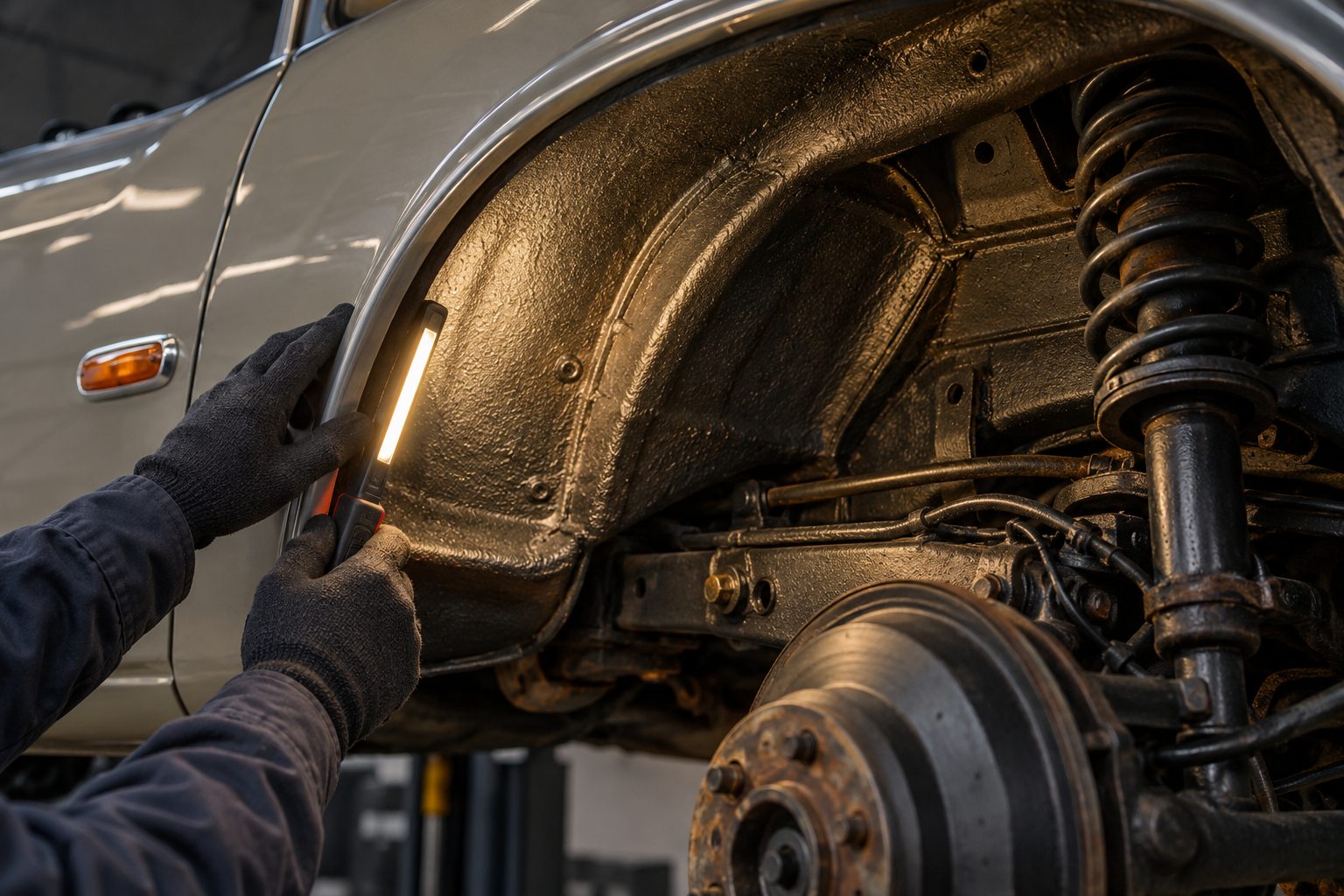
A useful inspection leaves a record you can compare later. This checklist helps organise observations and a workshop discussion; it cannot diagnose structural integrity or certify that a car is safe. Start before ordering a treatment, when you can still show the installer the original condition.
Choose a safe inspection scope
Start from outside the car on level ground, using good light. Look at areas visible without removing parts or getting underneath. Arrange workshop access for the underside and concealed sections. HSE warns against relying on jacks alone: correct vehicle lifting points, suitable rated equipment, hard level ground and secure wheel chocks are among its controls. This checklist is not a lifting procedure. If you lack the equipment or knowledge, book an inspection.
Do not probe structural metal, remove old underseal or drill access holes just to complete a checklist. Ask the workshop what investigation is appropriate and obtain permission for any dismantling.
Make one record per location
| Record | Useful detail |
|---|---|
| Identity | Vehicle, date, mileage and who inspected it |
| Location | Left or right, front or rear, panel and a nearby reference point |
| Appearance | Staining, blistering paint, lifting coating, loose scale, visible holes or water |
| Access | Clearly visible, partly obscured, or not inspected |
| Existing protection | Known product and application date, or explicitly unknown |
| Evidence | Wide photograph for location, closer photograph for detail |
| Action | Workshop assessment, leak investigation or planned comparison date |
Keep the original photographs and give files consistent names, such as date-location-wide and date-location-detail. A ruler beside an accessible area can make later photographs easier to compare; avoid contact with fragile metal. Record uncertainty rather than guessing a coating type or the depth of damage.
Record the date, the location of the affected area and clear photographs. Describe what you can see without assuming the condition beneath a coating. Note water entry, condensation or other observations separately as an environmental note. A hidden condition is a state not established by the available visual observations; write the inspection limits down rather than guessing.
Corrosion on a structural or safety-critical component needs competent assessment. Photographs and this checklist cannot establish remaining strength. GOV.UK says you are responsible for making sure a vehicle is always safe to drive, and that it can be unsafe even with a current MOT certificate. If the inspection means going under the vehicle, follow safe-access principles from HSE guidance on working under vehicles: do not rely on jacks alone, use the handbook’s lifting points, and only work under a properly supported vehicle.
Keep a starting condition record before treatment or storage so later change comparison uses the same views.
Work around the car systematically
Use the same route each time so overlooked areas remain obvious:
- Visible body edges: wheel-arch lips, lower door edges and accessible sill surfaces. Note paint bubbles and joins where dirt collects.
- Openings: accessible door and boot apertures, weather seals and signs of water. Identify drains using vehicle-specific information rather than pushing tools into unknown holes.
- Interior and luggage area: wet mats, damp trim or water traces. Separate the location of damp from an assumed entry point.
- Workshop underside inspection: ask for a record of areas inspected and areas concealed by shields, coatings or components. A clean-looking outer coating is not a view of the metal beneath it.
These are prompts for an organised record, not an exhaustive list of a particular model's corrosion points. A marque specialist can add known locations and suitable access methods.
Turn observations into a decision
| Finding | Useful next step |
|---|---|
| Water or damp recurs | Investigate the source before coating or covering |
| Unknown coating conceals condition | Ask how it will be assessed before specifying treatment |
| Loose scale, holes or uncertain structural areas | Seek competent assessment before choosing a protective product |
| No concern visible in accessible areas | Record the inspection limits and arrange access where necessary |
An MOT certificate does not guarantee continuing roadworthiness. GOV.UK puts responsibility for vehicle safety on the user. If a finding raises concerns about safe driving, seek qualified advice before using the car; photographs and this checklist cannot resolve that decision.
Agree the workshop handover
Ask for findings and proposed repairs separately from optional protection. Request the exact products, surface preparation, exclusions, access plan, photographs and a follow-up inspection recommendation. Keep the invoice and product information with the baseline record. If the proposal simply says “rust treatment”, ask which surfaces and condition it covers.
Use cavity wax explained for enclosed sections and underbody protection for exposed surfaces. For damp symptoms, begin with the garage moisture checklist. After treatment, repeat comparable photographs at the agreed inspection interval and after any damage, rather than assuming the record is finished.
Terms used here
- Corrosion: deterioration of a material through interaction with its environment.
- Hidden condition: a state not established by the available visual observations.
- Environmental note: a record of relevant surrounding conditions, such as water entry or condensation.
- Starting condition: the recorded state before a storage or treatment period.
- Change comparison: a comparison between observations made at different times.
Sources
- HSE: working under vehicles — checked 15 November 2026; workplace lifting guidance, used here for safe-access principles.
- GOV.UK: check your vehicle is safe to drive — checked 15 November 2026; responsibility for roadworthiness.
The record format and workshop questions are editorial planning aids.
Sources & checks
Checked 2026-11-15. Read the original instructions before acting.